

 Bahasa Indonesia
 Deutsch
 Español
 Français
 Português (Brasil)
 Türkçe
 ไทย
 中文(简体)
 中文(繁體)
 日本語
 한국어
Exploring and mapping
A robot that wanders at random will not score much. This page shows how to go from wandering to exploring systematically. These are ideas to build on, not a complete solution.
Know where you are
Section titled “Know where you are”Tiles are 12 cm wide, so the GPS position gives you the tile. The position of the start is different in each world, so measure everything from there:
TILE = 0.12startX, _, startZ = gps.getValues() # At the start of the game
def currentTile(): x, _, z = gps.getValues() return round((x - startX) / TILE), round((z - startZ) / TILE)Remember what you have seen
Section titled “Remember what you have seen”Keep a dictionary of tiles, with what you know about each one: which sides have walls, what the floor is, and whether you have visited it.
tiles = {}tiles[(0, 0)] = {"walls": {"N": False, "E": True, "S": False, "W": True}, "floor": "start", "visited": True}The tiles do not tell the whole story in Areas 2 and 3, where walls can be on quarter tiles. Storing the map at the resolution of quarter tiles, or using a Lidar point cloud, will prepare you for them.
Decide where to go
Section titled “Decide where to go”Do not just follow a wall: that never reaches floating tiles, whose tokens are worth more. A common approach is:
- From the current tile, list the neighbours with no wall in between.
- Go to an unvisited one, if there is one.
- If not, find the nearest tile with an unvisited neighbour with a breadth-first search, and go there.
- When no such tile is left, or time runs low, return to the start the same way.
Treat holes as walls. Swamps cost time, and more each time you enter the same one, so visit them only when worthwhile.
Handle the unexpected
Section titled “Handle the unexpected”- Lack of progress: the robot is moved to the last checkpoint. Listen for the
Lmessage, and update your position. - Time: ask for the time left with
G. Leave enough to send the map and return to the start. - Noise: sensors are noisy, so compare several readings before trusting a wall or a token.
From tiles to the map matrix
Section titled “From tiles to the map matrix”The map matrix has 4 cells per tile, plus one. For a tile in row r and column c of your map:
| Element | Matrix position (row, column) |
|---|---|
Floor marks, such as 4 or 5 |
Rows 4r + 1 and 4r + 3, columns 4c + 1 and 4c + 3 |
| North wall | Row 4r, columns 4c to 4c + 4 |
| West wall | Column 4c, rows 4r to 4r + 4 |
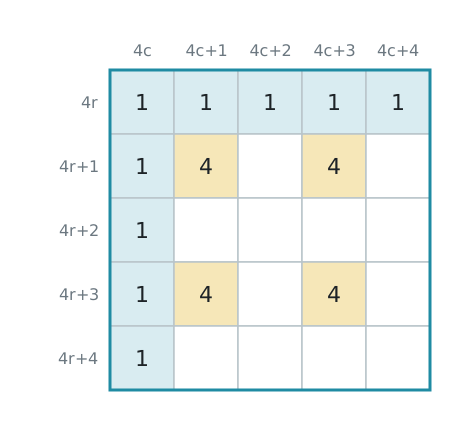
Your map can start anywhere: Erebus aligns the matrix using the starting tile, and it tries the four rotations. The Mapping rules explain every value of the matrix. Then submit it.
Test it with the example worlds, whose correct answers are in Mapping rules. The result appears as Map Correctness in the history of the control window.

Erebus is part of RoboCupJunior Rescue.
News, events and team documents: RCJ Rescue Community Website
© 2020–2026 Erebus Development Team